
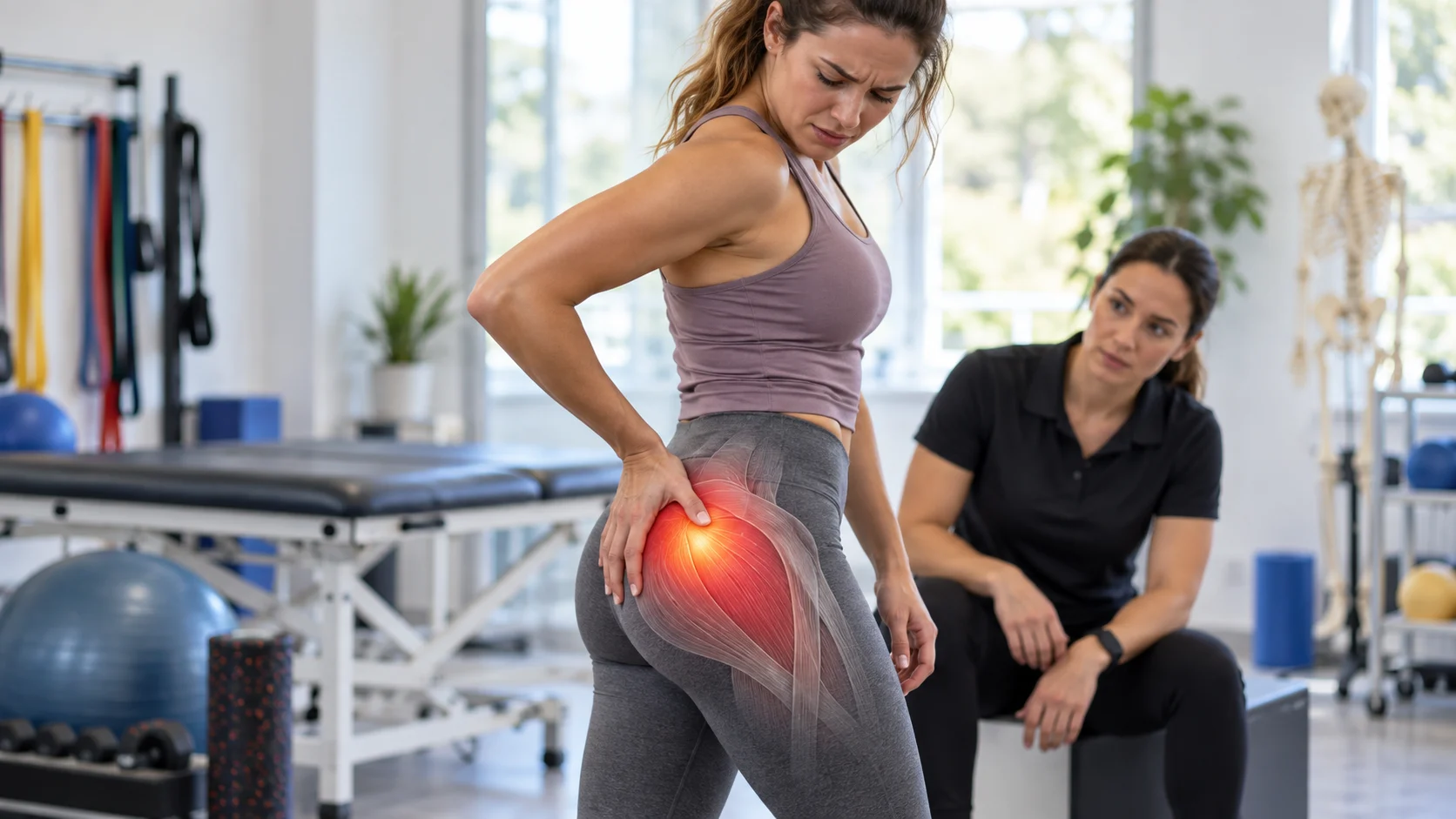
Gluteal tendinopathy is a common cause of pain around the outside of the hip. It involves irritation or reduced load tolerance in the tendons that connect the gluteal muscles to the upper part of the thigh bone. Symptoms may develop gradually and can make walking, climbing stairs, sleeping on one side, or standing on one leg uncomfortable.
Although rest may temporarily reduce symptoms, long-term recovery often depends on gradually rebuilding the tendon’s ability to handle everyday and exercise-related loads. Understanding what aggravates the condition, how to modify activity, and which strengthening strategies are commonly used can help you manage symptoms more effectively. Persistent or severe hip pain should still be assessed by a qualified healthcare professional.
What Is Gluteal Tendinopathy?
Gluteal tendinopathy affects the tendons of the gluteus medius and gluteus minimus muscles near the outside of the hip. These tendons help stabilize the pelvis when you walk, run, climb stairs, or stand on one leg. When they become overloaded or less able to tolerate repeated stress, pain and tenderness may develop around the greater trochanter.
The condition was once commonly described as trochanteric bursitis because pain appears in a similar region. However, many cases of persistent lateral hip pain involve the gluteal tendons rather than inflammation of the bursa alone. For this reason, clinicians may use terms such as greater trochanteric pain syndrome or gluteal tendinopathy when describing the problem.
Tendinopathy does not necessarily mean the tendon is torn. It usually reflects changes in how the tendon responds to loading over time. Appropriate exercise, activity modification, and gradual strengthening can often improve function, although recovery may take several weeks or months depending on symptom severity and duration.
What Causes Gluteal Tendinopathy?
Gluteal tendinopathy often develops when the tendons experience more load than they can currently tolerate. This may happen after suddenly increasing walking, running, hill training, gym workouts, or other physical activity. A rapid change in exercise volume can irritate the tendon even when the activity itself would normally be considered healthy.
Repeated compression can also aggravate the outside of the hip. Positions such as standing with the hip pushed to one side, crossing the legs, or sleeping directly on the painful hip can increase pressure around the gluteal tendons. These habits may not cause the condition alone, but they can make existing symptoms more persistent.
Age, reduced strength, previous injury, and changes in activity level may also contribute. Tendons adapt to regular loading, so both sudden overuse and long periods of underuse can reduce tolerance. The problem often develops from a combination of factors rather than one single movement or isolated mistake.
Common Symptoms of Gluteal Tendinopathy
The most common symptom is pain on the outside of the hip, usually near the bony prominence at the upper side of the thigh. The area may feel tender when pressed, and discomfort may spread slightly down the outer thigh. Pain is often described as aching, sharp, or sensitive depending on the activity.
Sleeping on the affected side can be particularly uncomfortable because body weight compresses the irritated tissues. Some people also feel pain when lying on the opposite side if the upper leg falls inward across the body. A pillow between the knees may reduce this compression and make side sleeping more comfortable.
Symptoms often become noticeable during walking, stair climbing, running, or standing on one leg. Getting out of a chair or walking uphill may also trigger discomfort. In more persistent cases, the hip can feel weak or easily fatigued, especially during activities that require repeated pelvic stabilization.
Who Is More Likely to Develop It?
Gluteal tendinopathy can affect active and inactive people, but it becomes more common with age. It is frequently seen in middle-aged and older adults, particularly when strength, tendon capacity, and activity levels change. Hormonal and musculoskeletal changes may also influence how the tendon responds to repeated load.
Runners and recreational athletes can develop symptoms after increasing training distance, speed, hills, or frequency too quickly. People who begin a demanding exercise program after a long period of inactivity may face similar problems. The tendon needs time to adapt to increasing loads rather than being exposed immediately to high-volume activity.
Certain movement habits may increase compression around the outside of the hip. Standing with most of your weight on one leg, repeatedly crossing your legs, or allowing the hip to drop inward during movement may contribute in some individuals. These patterns are usually considered alongside overall strength, activity, and symptom history.
How Is Gluteal Tendinopathy Diagnosed?
Diagnosis usually starts with a discussion about where the pain occurs and which activities make it worse. A healthcare professional may ask about walking, running, sleep, previous injuries, exercise changes, and how long symptoms have been present. The pattern of lateral hip pain often provides useful clues about whether the gluteal tendons are involved.
A physical examination may include checking tenderness around the outer hip and testing strength during movements that load the gluteal muscles. Standing on one leg, resisting hip movement, or performing functional tasks may reproduce symptoms. These tests help distinguish gluteal tendinopathy from hip joint problems, lower-back pain, or other causes of discomfort.
Imaging is not always necessary. Ultrasound or MRI may be considered when the diagnosis is uncertain, symptoms are severe, or treatment has not produced the expected improvement. Imaging findings should still be interpreted alongside symptoms because tendon changes can sometimes appear even in people who do not have hip pain.
Gluteal Tendinopathy Treatment Options
Treatment usually begins with reducing activities and positions that repeatedly aggravate the tendon. This does not necessarily mean complete rest. Instead, the goal is to lower painful loading temporarily while maintaining enough comfortable movement to prevent unnecessary weakness and loss of fitness.
Pain management may include temporary activity modification, comfortable sleep positioning, and other strategies recommended by a healthcare professional. Medication may be appropriate for some people, but it should be used according to medical or product guidance. Treatment should address the factors maintaining the problem rather than only covering symptoms.
Physical therapy is commonly used because progressive strengthening can improve the tendon’s ability to tolerate load. A therapist may assess hip strength, walking patterns, movement control, and daily habits before selecting exercises. The program is then progressed gradually based on how symptoms respond rather than following the same routine for every person.
Best Exercises for Gluteal Tendinopathy
Early exercises often focus on controlled gluteal strengthening without creating substantial pain. Isometric hip-abduction exercises may be used to activate the gluteal muscles while limiting large joint movements. Depending on your symptoms, these can be performed against a wall, resistance band, or another stable surface.
As tolerance improves, exercises may progress to bridges, side steps with resistance bands, squats, step-ups, and other movements that strengthen the hips and lower body. The goal is not simply to feel the glute muscles burning. Exercises should gradually prepare the tendon for walking, stairs, running, work, or whatever activities matter to you.
Technique matters during rehabilitation. Just as simple movements such as chin tucks rely on controlled form rather than excessive force, gluteal exercises should be performed with good alignment and manageable resistance. Progressing too quickly can irritate the tendon instead of building its capacity.
Activities and Positions to Modify
Sleeping directly on the painful hip may increase compression and make nighttime symptoms worse. Try lying on the opposite side with a pillow between your knees, or sleep on your back if that feels better. The goal is to reduce prolonged pressure without forcing yourself into an uncomfortable position.
Standing with your weight heavily shifted onto one hip can also aggravate symptoms. Try distributing your weight more evenly between both legs when standing for extended periods. Crossing your legs while sitting may also increase hip compression, so a more neutral sitting position can be useful during painful periods.
Walking and exercise may need temporary adjustment rather than complete avoidance. Shorter walks on flatter terrain can be easier than long walks involving hills or stairs. Once symptoms settle, activity can be increased gradually so the tendon becomes stronger without repeatedly experiencing major flare-ups.
How Long Does Gluteal Tendinopathy Take to Heal?
Recovery time varies considerably from person to person. Mild symptoms may begin improving within several weeks when aggravating loads are reduced and appropriate strengthening is introduced. Long-standing tendinopathy often takes longer because the tendon and surrounding muscles need time to rebuild capacity gradually.
Improvement is rarely perfectly linear. You may have several good days followed by a temporary increase in soreness after a more demanding activity. A mild short-lived response does not always mean you have caused damage, but significant or persistent worsening suggests that the current exercise or activity level may need adjustment.
Progress should be measured through function as well as pain. Walking farther, sleeping more comfortably, climbing stairs more easily, and tolerating stronger exercises can all indicate improvement. Returning immediately to your previous activity level as soon as pain decreases may increase the chance of symptoms returning.
Can You Walk or Exercise With Gluteal Tendinopathy?
Many people can continue walking with gluteal tendinopathy as long as the amount and intensity are appropriate. If long walks cause a significant increase in pain, reduce the distance temporarily. Flat routes may be easier than hills because uphill walking can place additional demand on the hip muscles.
Strength training is often part of recovery rather than something that must be completely avoided. Exercises should be selected according to your current tolerance and progressed gradually. If a movement produces sharp pain or causes symptoms to remain substantially worse afterward, reducing resistance, range, or volume may be appropriate.
Running may need more careful modification, particularly when symptoms are significant. Some runners temporarily reduce mileage, avoid hills, or replace certain sessions with lower-impact exercise. A gradual return based on strength and symptom response is usually more sustainable than repeatedly stopping completely and then resuming full training.
When Should You See a Doctor or Physical Therapist?
Consider professional evaluation if hip pain has lasted several weeks, repeatedly returns, or interferes with sleep and daily activities. A physical therapist or healthcare professional can assess whether the gluteal tendons are likely involved and identify factors that may be maintaining the problem.
Seek medical attention sooner if pain begins after a significant fall or injury, or if you cannot bear weight normally. Severe swelling, marked weakness, fever, redness, or rapidly worsening symptoms should also be assessed. These features may indicate a problem other than routine tendon irritation.
Persistent hip pain can sometimes come from the hip joint, lower back, nerves, or other nearby structures. This is why self-diagnosis has limits when symptoms do not follow the expected pattern. Getting an appropriate assessment can help prevent months of using exercises that do not address the actual cause.
How to Reduce the Risk of Gluteal Tendinopathy Returning
Increase activity gradually, especially after a break from regular exercise. Large jumps in running distance, walking volume, hill training, or resistance can overload the tendon before it has adapted. Smaller increases give the gluteal muscles and tendons time to become stronger alongside your training.
Maintain lower-body strength even after symptoms improve. Squats, step-ups, bridges, and other appropriate exercises can help preserve hip capacity when performed consistently. You do not need to train maximally, but completely abandoning strengthening once pain disappears may allow previous weakness to return.
Pay attention to early warning signs. Mild recurring tenderness after activity can be a signal to review recent changes in workload before symptoms become more persistent. Adjusting training early is usually easier than waiting until pain starts affecting sleep, walking, or everyday movement.
Conclusion
Gluteal tendinopathy is a common source of pain on the outside of the hip and often develops when the gluteal tendons become overloaded or repeatedly compressed. Symptoms commonly appear during walking, climbing stairs, standing on one leg, and sleeping on the affected side. The problem can be uncomfortable, but many cases respond well to appropriate management.
Treatment usually focuses on reducing irritating positions while gradually strengthening the gluteal muscles and rebuilding tendon tolerance. Complete rest is rarely the long-term answer because tendons need progressive loading to regain capacity. The challenge is finding an amount of activity that encourages adaptation without repeatedly triggering significant flare-ups.
If hip pain is severe, persistent, worsening, or affecting your ability to walk normally, professional assessment is recommended. A physical therapist or healthcare provider can help determine whether gluteal tendinopathy is the likely cause and develop an individualized plan. Gradual progress, consistent strengthening, and sensible activity changes are usually central to recovery.
FAQs
What does gluteal tendinopathy feel like?
It usually causes aching or tenderness on the outside of the hip. Pain may worsen when walking, climbing stairs, standing on one leg, or sleeping directly on the affected side.
Is walking good for gluteal tendinopathy?
Walking can often be continued if symptoms remain manageable. Shorter, flatter walks may be more comfortable initially, while long distances and hills may need temporary reduction during painful periods.
What exercises help gluteal tendinopathy?
Common rehabilitation exercises include isometric hip abduction, bridges, banded side steps, squats, and step-ups. The correct exercise level depends on your symptoms, strength, and current tendon tolerance.
How long does gluteal tendinopathy last?
Mild cases may improve within several weeks, while persistent symptoms can take months. Recovery depends on duration, activity levels, strength, load management, and how consistently rehabilitation is progressed.
Should you stretch gluteal tendinopathy?
Aggressive stretching is not always helpful because some positions increase compression around the gluteal tendons. Gentle mobility may be appropriate, but strengthening and sensible load management are usually more important for long-term recovery.