
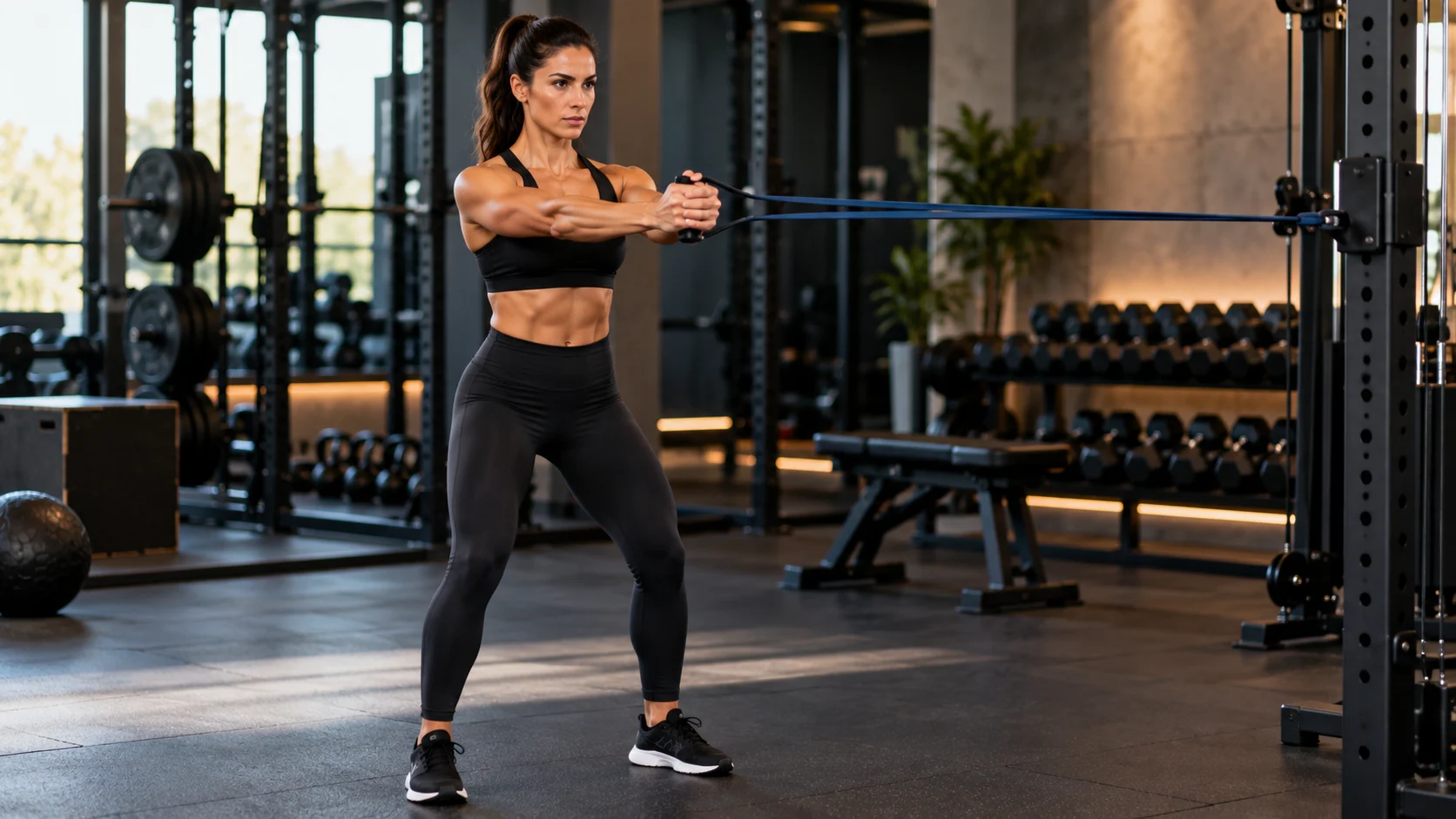
The standing Pallof press is a simple-looking core exercise that can challenge your trunk more than you might expect. Instead of bending, twisting, or performing repeated crunches, you resist rotational force while pressing a cable or resistance band away from your body. This makes the exercise useful for developing core stability, balance, posture, and controlled movement.
Because the Pallof press can be adjusted easily, it works for beginners, experienced gym users, and athletes. You can change the resistance, stance, distance from the anchor point, or pressing position to make it easier or harder. Learning proper form matters because the goal is resisting rotation rather than simply moving the hands forward and backward.
What Is a Standing Pallof Press?
The standing Pallof press is an anti-rotation core exercise performed with a resistance band or cable machine positioned to one side of the body. You hold the handle or band near your chest and press your hands straight forward. As the resistance pulls you sideways, your core works to prevent your torso from rotating.
Unlike traditional abdominal exercises, the Pallof press does not require repeated spinal flexion. Instead, it trains your abdominal muscles to stabilize the trunk while external force tries to twist you. This type of stability is useful during everyday movements, strength training, running, carrying objects, and many sports.
The standing version also challenges the hips and lower body because you must maintain balance while resisting the sideways pull. Your feet, glutes, and trunk work together to keep your body steady. This makes the exercise more functional than simply training the abdominal muscles in isolation.
What Muscles Does the Standing Pallof Press Work?
The Pallof press primarily trains the muscles responsible for core stability. These include the transverse abdominis, internal and external obliques, rectus abdominis, and deeper stabilizing muscles surrounding the spine. Their main job during this exercise is preventing unwanted rotation rather than producing large visible movement.
Your glutes and hip muscles also contribute to keeping your pelvis stable. When standing, the lower body must resist the sideways force created by the cable or resistance band. This helps connect core control with hip stability, which is useful for squats, deadlifts, lunges, running, and other full-body movements.
The shoulders, chest, and arms assist while pressing the resistance away from your torso. However, they should not become the main focus of the exercise. If your arms are working extremely hard while your body rotates, the resistance is probably too heavy for effective anti-rotation training.
Benefits of the Standing Pallof Press
One of the biggest benefits of the standing Pallof press is improved core stability. Your trunk learns to stay controlled while external resistance attempts to pull you out of position. This type of strength can help you maintain better alignment during lifting, walking, running, and other movements that involve transferring force through the body.
The exercise can also improve rotational control. Many activities require the body to resist twisting, including carrying groceries on one side, changing direction during sports, or holding weight during a split stance. Training anti-rotation can make these situations feel more stable and controlled.
Another advantage is that the Pallof press is relatively easy to scale. Beginners can use a light resistance band, while experienced lifters can increase cable resistance or choose more challenging variations. Because the exercise does not require heavy spinal loading, it can also fit well into warm-ups, rehabilitation programs, or accessory training.
How to Do the Standing Pallof Press Correctly
Attach a resistance band or cable handle around chest height and stand sideways to the anchor point. Hold the handle with both hands close to your sternum, then step away until you feel moderate tension. Place your feet about shoulder-width apart and soften your knees slightly instead of locking them.
Brace your core gently and keep your ribs stacked over your pelvis. Press your hands slowly straight in front of your chest without allowing your torso to rotate toward the anchor. Pause briefly with your arms extended, then bring your hands back toward your chest under control.
Complete the desired number of repetitions before turning around to train the opposite side. Keep your breathing steady instead of holding your breath through every repetition. The movement should look calm and controlled; if you are twisting, leaning, or being pulled sideways, reduce the resistance.
How to Breathe During the Pallof Press
Breathing properly can make the exercise more effective because the diaphragm and abdominal muscles contribute to trunk stability. Begin by taking a comfortable breath while your hands are close to your chest. As you press forward, exhale gently while maintaining enough abdominal tension to prevent your torso from rotating.
Avoid aggressively sucking your stomach inward or holding your breath for long periods. The goal is to maintain controlled abdominal pressure while still breathing normally. If you cannot breathe comfortably, the resistance may be too high or you may be bracing more strongly than necessary.
Breathing and pressure management are also connected to pelvic floor function. People experiencing pelvic pressure or symptoms such as pain during bowel movements may benefit from avoiding excessive straining and discussing persistent symptoms with an appropriate healthcare professional. Exercise should feel controlled rather than forceful.
Common Standing Pallof Press Mistakes
One common mistake is using too much resistance. When the band or cable is too heavy, your body may rotate toward the anchor, your shoulders may twist, or your hips may shift sideways. This reduces the anti-rotation benefit because you are no longer maintaining a stable position.
Another mistake is turning the movement into an arm exercise. The hands should press forward smoothly while the trunk remains quiet. If your shoulders fatigue before your core or you are pushing as hard as possible with your arms, reduce the resistance and focus on keeping your torso stable.
Poor posture can also reduce effectiveness. Excessively arching the lower back, flaring the ribs, or leaning away from the cable changes the position of the trunk. Aim for a tall, neutral stance with relaxed shoulders and enough abdominal engagement to keep the ribs and pelvis controlled.
How Much Resistance Should You Use?
Choose a resistance that challenges your core without pulling you out of alignment. You should feel tension as soon as you step away from the anchor, but you should still be able to press your hands forward smoothly. If your torso twists or your feet shift during every repetition, the load is too heavy.
Beginners often benefit from lighter resistance because it gives them time to understand the movement. Anti-rotation exercises are not about moving the heaviest possible weight. The quality of your position matters more than the number displayed on a cable stack or the thickness of the resistance band.
As you improve, increase resistance gradually while maintaining the same controlled form. You can also make the exercise harder by stepping farther from the band anchor, narrowing your stance, increasing the pause time, or progressing to more challenging stance variations instead of immediately adding a large amount of weight.
How Many Sets and Reps Should You Do?
A useful starting point is two to three sets of eight to twelve controlled repetitions on each side. You can pause briefly when your arms are fully extended to increase the stability challenge. The exact number of repetitions depends on your training goals, experience, and how the exercise fits into the rest of your workout.
You can also perform the Pallof press using timed holds. Press the hands forward and maintain the position for ten to thirty seconds while keeping your body completely stable. Isometric holds can help you develop endurance and awareness before progressing to heavier resistance or more complicated variations.
Quality should remain the priority throughout every set. Stop when fatigue causes noticeable twisting, leaning, breath-holding, or loss of posture. Adding extra repetitions after your form deteriorates does not provide the same benefit as completing fewer repetitions with consistent control.
Best Standing Pallof Press Variations
The split-stance Pallof press places one foot in front of the other and creates an additional balance challenge. This position can help connect core stability with movements used during walking, running, and lunging. Keep both feet firmly planted and avoid allowing the pelvis to rotate as you press forward.
A half-kneeling Pallof press is another useful option, although it is not technically a standing variation. Kneeling reduces lower-body movement and can make it easier to focus on trunk control. It is particularly helpful for people who struggle to understand anti-rotation mechanics when first learning the exercise.
For a more advanced challenge, try a narrow-stance or single-leg Pallof press. Reducing your base of support forces the hips and core to work harder to maintain balance. Use lighter resistance when trying these variations because stability usually becomes more difficult before the cable load increases.
When to Include the Pallof Press in Your Workout
The standing Pallof press works well during a warm-up because it activates the core without creating large amounts of fatigue. One or two light sets before squats, deadlifts, presses, or athletic training can help you practice trunk control. Keep the resistance moderate when using it as preparation for heavier exercises.
You can also perform it later in a workout as a dedicated core exercise. Pairing the Pallof press with planks, carries, dead bugs, or other stability-focused movements can create a balanced core routine. Because it emphasizes anti-rotation, it complements exercises that train flexion, extension, or lateral stability.
Athletes may include Pallof press variations during strength and conditioning sessions. Sports often involve resisting rotation while running, throwing, striking, or changing direction. Practicing trunk stability under controlled resistance can help build the foundation needed for more complex athletic movements.
Standing Pallof Press vs Plank
Both exercises train core stability, but they challenge the body differently. A plank primarily requires you to resist extension and maintain a straight position against gravity. The Pallof press introduces a sideways rotational force, making the obliques and anti-rotation muscles work in a different way.
Planks may be easier to perform without equipment, which makes them convenient for home workouts. The Pallof press requires a resistance band or cable machine, but it allows resistance to be adjusted more precisely. Both exercises can be valuable when used as part of a well-rounded training program.
You do not need to choose one over the other. Using planks alongside Pallof presses gives your core different stability challenges. The best routine usually includes multiple movement patterns rather than relying on one exercise to develop every aspect of trunk strength.
Who Should Do the Standing Pallof Press?
The standing Pallof press can be useful for beginners because the movement is simple and easy to modify. People learning strength training can use it to understand what core stability feels like without performing complicated exercises. Starting with light resistance makes it easier to focus on posture and breathing.
Experienced lifters can also benefit because stronger legs or arms do not automatically guarantee excellent trunk control. Pallof press variations can expose asymmetries and challenge stability without interfering heavily with recovery. This makes the exercise useful as an accessory around more demanding compound lifts.
Athletes, runners, recreational exercisers, and people returning to training may all use the movement appropriately. However, anyone with significant back pain, pelvic symptoms, recent surgery, or another medical condition should seek individualized guidance before beginning a new exercise program if they are unsure what is safe.
How to Progress the Standing Pallof Press
Progress should begin with better control rather than heavier resistance. Aim to maintain a stable ribcage, neutral pelvis, and steady breathing throughout each repetition. Once the basic version feels easy and you can resist rotation consistently, you can make the exercise more challenging in several ways.
Increase the cable weight or band tension in small steps rather than making a large jump. You can also extend the pause at full arm extension, perform slower repetitions, or take another small step away from the anchor. Each change increases the amount of time or force your core must resist.
More advanced progressions include split stances, narrow stances, overhead presses, step-outs, and single-leg variations. Only introduce one difficulty at a time so you can maintain good form. A harder variation is useful only when you can control it without twisting or compensating through the lower back.
Best Practices for Safe and Effective Training
Always prioritize control over resistance. The Pallof press works because your body resists movement, so visible twisting usually means the exercise is becoming less effective. Choose a load that allows you to feel challenged while still maintaining a stable posture from the beginning to the end of each set.
Keep your shoulders relaxed and your knees slightly soft. Avoid locking the joints or creating unnecessary tension through the neck and jaw. A comfortable athletic stance allows your trunk and hips to respond naturally to the sideways resistance without making the exercise feel stiff.
Finally, progress based on your individual ability rather than copying someone else’s cable weight. Two people can perform the same exercise with very different resistance levels and still receive an effective training stimulus. Consistency, controlled breathing, and gradual progression are more important than chasing heavy numbers.
Conclusion
The standing Pallof press is an effective anti-rotation exercise that strengthens the core by teaching your body to resist twisting. It also challenges the hips, glutes, shoulders, and lower body to maintain stable alignment. Because the exercise is easy to modify, it can fit into beginner routines, advanced strength programs, and athletic training.
Proper form matters more than heavy resistance. Stand tall, keep your ribs and pelvis controlled, press your hands straight forward, and resist the pull from the cable or band. If your torso rotates or your breathing becomes difficult, reduce the load and focus on regaining control.
You can perform the standing Pallof press during a warm-up, as part of a core workout, or alongside major compound exercises. Gradually increase resistance or move to more challenging variations as your stability improves. With consistent practice, the exercise can become a valuable tool for developing stronger and more coordinated trunk control.
FAQs
What does the standing Pallof press work?
The standing Pallof press primarily works the obliques, transverse abdominis, rectus abdominis, and other trunk stabilizers. The glutes, hips, shoulders, and legs also contribute to keeping your body stable.
Is the Pallof press good for beginners?
Yes. Beginners can use a light resistance band or cable and focus on maintaining a stable torso. The exercise is easy to modify and teaches useful core bracing and anti-rotation control.
How often should I do Pallof presses?
Two to three sessions per week can work well for many people, depending on the rest of their program. You can perform two to three controlled sets on each side.
Should I feel the Pallof press in my abs?
Yes, you should feel your core working to prevent rotation, particularly around the sides of your abdomen. You should not feel sharp pain or excessive strain in your lower back.
Is the Pallof press better than crunches?
Neither exercise is universally better because they train different functions. Crunches emphasize trunk flexion, while Pallof presses emphasize resisting rotation. Including different core exercises can create a more balanced training program.